The Q3 Retail crash
July retail sales report sets up Q3’21 as the worst ever quarter. It raises fresh questions about on the RBA’s Aug SOMP forecasts. And reminds us what is different about the Q3’21 lockdowns.
macro, politics, markets, ambivalence


July retail sales report sets up Q3’21 as the worst ever quarter. It raises fresh questions about on the RBA’s Aug SOMP forecasts. And reminds us what is different about the Q3’21 lockdowns.

Q2 GDP is tracking 40bps below the RBA’s August SOMP forecast. Weekly payrolls suggest job losses in NSW are similar to the first COVID lockdowns.

The weak Q2 CWD release confirms my hunch that housing won’t drive growth any longer. It also shaved about 30bps from my tracking of the RBA’s GDP forecast (now +0.4%qoq).

The RBA can push back the constraints on their Bond Purchase Program by buying beyond May’32 and buying more Semis. Doing both would create scope to ease policy by accelerating QE, if that was required.
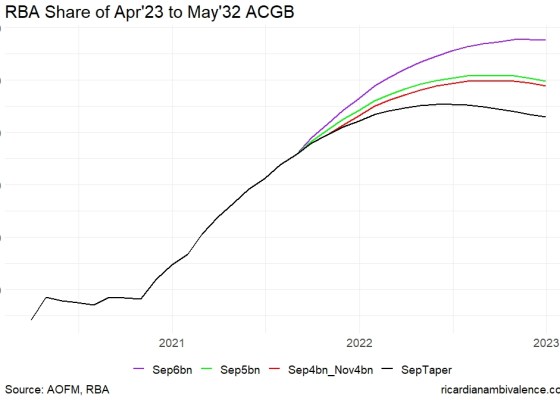
There are three main problems with RBA QE: The RBA owns too large a share of the lines it does buy. The tenor of the bonds they buy is shortening. And Semis want to issue longer than the RBA buys to fund infrastructure.

The difficulty controlling Delta/COVID means that we are being urged to “learn to live with the virus”. This is a big existential change from H1’21, and a reason to think that this recovery may be more subdued than the H2’20 bounce.

The gross flows data shows that the NSW lockdowns in July were damaging. The longer the lockdown, the greater the damage … so the worst is yet to come.
The minutes to the RBA’s August meeting confirm that the Board did discuss reversing July’s decision to taper bond purchases
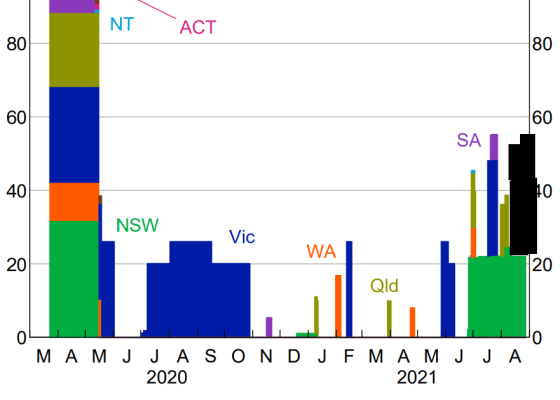
The lockdown situation is twice as bad as the RBA had in their August SOMP. Using Gov Lowe’s rule of thumb that consumption falls 15%, a Q3’21 GDP forecast of around -3% seems plausible (v. RBA -1% in the Q3 SOMP). The probability that the taper is dropped in Sep is rising.

The RBA has ‘looked through’ the delta-outbreak, and retained some of the upgrade that drove the July taper. A downgrade that drives easing is plausible, but it’ll take some time for the data to make the case
The RBA eschewed the signal-value of reversing the taper. My hunch is that they are worried about their market footprint and housing.
 ricardian ambivalence